


June 10, 2026

31

42 mins 26 seconds
The CFO’s AI Playbook: How to Roll Out AI Across Your Company, with Ryan Roccon
Listen on


Play Video

For a while, AI adoption inside companies was happening in pockets. A few people were using ChatGPT, some engineers were testing coding tools in their corner and someone in marketing had built a clever workflow.
But that phase is now well and truly over.
AI has moved from experimentation to expectation. And for finance leaders, that raises a much bigger question: how do you roll it out across the company in a way that genuinely changes how work gets done?
That’s the question at the heart of this episode of The Growth-Minded CFO, featuring Ryan Roccon, CFO at Zapier.
Ryan has had a front-row seat to this change. He joined Zapier as controller when the company was around 150 people, then spent the next few years building out the finance function and several adjacent areas of the business, from accounting, tax and FP&A to procurement, legal, data, business operations, pricing and packaging.
Then, seeing the writing on the wall, Zapier “called a code red” on AI back in 2023. Ryan has been part of leading the charge rethinking how the company operates with AI at it’s core.
Crucially, as CFO, Ryan doesn’t treat AI as another line item to manage. As he discusses in the episode, his view is that the CFO’s role is not simply to control the cost of AI but to help the business move quickly enough (by allocating the capital required) to understand what AI can really unlock.
Give people AI access before you demand perfect ROI
One of the episode’s clearest messages is that companies cannot learn what AI can do if they keep access too tightly controlled.
At Zapier, the approach Ryan and the team have taken has been deliberately broad. Employees across the company have access to a wide range of AI tools, from OpenAI and Anthropic products to Cursor, meeting recorders and more specialised tools where needed.
That includes finance. Ryan even mentions accountants using Cursor - not because every accountant suddenly needs to become a software engineer, but because the boundary between technical and non-technical work is shifting.
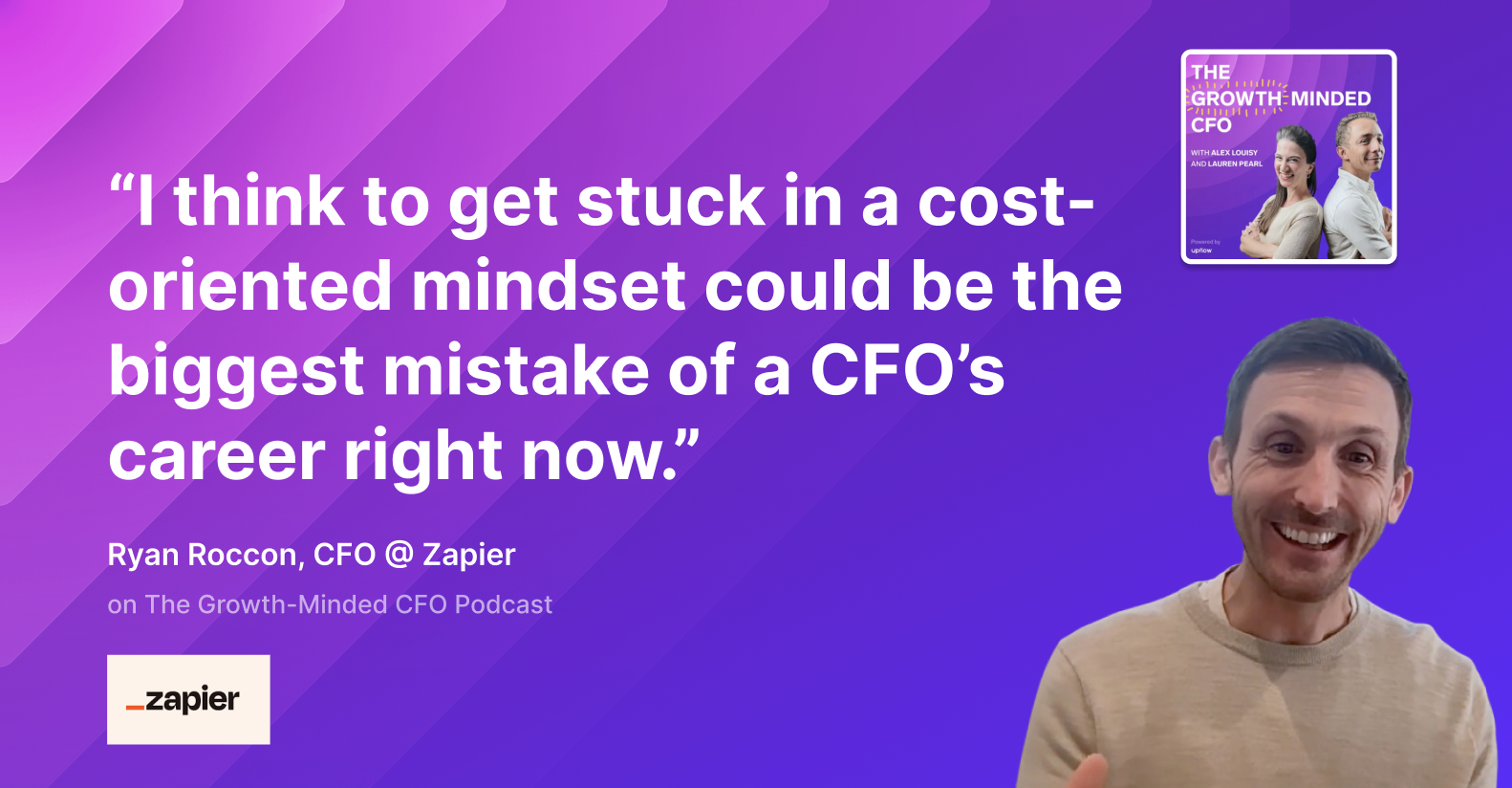
Now, the first thing that comes to mind when you hear that must be “how can they afford that?”. After all, that kind of access is not cheap. The bills can add up quickly and there’s risk - especially when people are moving fast and testing new tools in real workflows.
But Ryan’s view is that the bigger risk is getting left behind.
“Don’t let cost be the burden that stops you from experimenting and learning and growing and finding what works… because the cost of not doing it is so great.”
If a company demands a perfect business case before people have had enough time to understand the tools, it will almost certainly underestimate the upside. That’s why Ryan argues against obsessing over ROI too early.
And don’t jump to conclusions here - it’s not that ROI does not matter. Ryan stresses that it absolutely does. But the point is that it may not be the right starting point.
First, people need access. Then the business needs enough visibility to understand how the tools are being used. Only then can finance start making smarter decisions about where to double down, where to optimise, and where to pull back.
In other words, the CFO should not start by asking, “Can we prove the ROI today?” A better first question might be: “Are we learning fast enough to know where the ROI could come from?”
Make AI adoption a company-wide operating system, not a side project
But giving everyone access doesn’t automatically lead to adoption. Plenty of companies have given people AI tools and still seen usage remain shallow. A few people run with them and others keep working exactly as they did before.
Zapier has tried to avoid that by making AI part of how the company operates. In the episode, Ryan describes AI usage as a top-down expectation. It’s literally now part of the way people are hired, managed and encouraged to think about their work.
As Ryan puts it: “This is part of your job. You have to use these tools…You can’t sort of stand by and just watch these things happen.”

But Zapier doesn’t stop at simply telling people to use AI and hoping for the best - they have built structures around it. The company has a formal AI transformation programme, led by a single owner, with named AI transformation leaders in each function.
Those functional leaders are responsible for helping their teams identify meaningful use cases, prioritise the work, track usage and share what is being built. Zapier also publishes quarterly case studies by function, showing the capabilities different teams have unlocked.
That matters because AI adoption can easily become fragmented. One team builds something useful. Another team never hears about it. One person finds a better way to complete a task. Nobody else learns from it.
Ryan’s point is that companies need mechanisms to turn individual experimentation into organisational learning.
At Zapier, that also means giving people dedicated time to build. Ryan says the company gives employees a week each quarter to clear their calendars, step away from normal deliverables, and focus on building with AI. At the end, teams showcase what they have created.
That is a very different signal from telling people to “experiment with AI” while leaving their workload unchanged.
It tells the company that this matters. It gives people permission to learn. And it creates a rhythm where AI adoption becomes visible, shared and celebrated.
Measure everything, but don't overanalyze too early
Ryan is not advocating for blind experimentation with AI - he wants the company to move fast, but he also wants to know what is happening.
That means building the measurement infrastructure to see where AI tools are being used, how they are being used, where adoption is strong, and where there are gaps.
If one team is not using the tools, managers can dig into why. Is it a lack of access? A lack of confidence? A lack of time? Or a lack of willingness? Without telemetry, those conversations become guesswork.
But Ryan also makes an important distinction: measurement should not become a reason to shut things down too quickly. Early AI usage data may be messy - the costs may look high and the output may not yet reflect the full potential of the tools.
As he puts it: “If you get obsessed with that too early, that you might find yourself sort of stuck in this analysis paralysis and not learning quickly enough to understand what the tools are capable of.”
If finance reacts too aggressively to the first version of the data, it risks killing useful experiments before they have had time to develop.
So the playbook is not “measure everything and immediately optimise everything.” It needs to be more nuanced than that.
For CFOs it comes down to this: not standing in the way of experimentation, but making sure the company is building enough visibility to learn from it.
Treat cost spikes as learning, not automatic failure
Of course, AI costs can get out of control.
Ryan shares a striking example from Zapier’s own experience: The company launched a Copilot within their product feature that allowed users to describe in natural language what they wanted to build. But because of how the system was handling context, it started caching huge numbers of tokens every time some users returned.
The result was a multi-hundred-thousand-dollar bill in a matter of weeks. One customer alone cost around $20,000 in a matter of hours.
In many companies, that would have triggered panic. It would have been treated as proof that the experiment was too risky, too expensive, or not ready.
Ryan saw it differently.
The problem needed to be fixed, of course. But the underlying signal was not bad - people were using the product and that was a good thing.
The team found the problem, fixed the caching issue, and moved forward. For Ryan, that was just part of the learning curve.
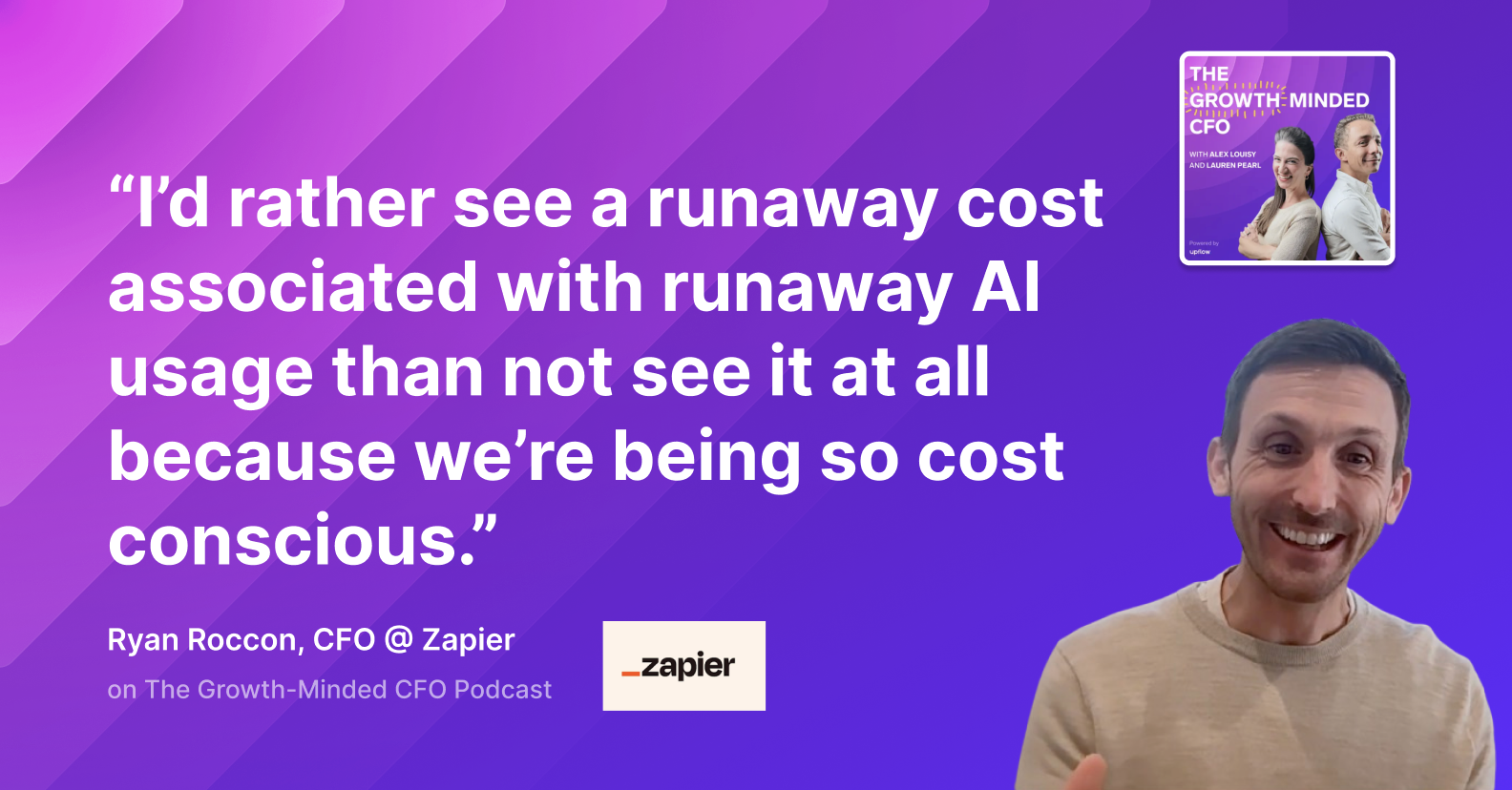
This example captures one of Ryan’s more important points: cost problems are often easier to fix than growth problems.
You can reduce usage, change the architecture and add limits. But if a company falls behind on product capability, customer experience or internal productivity, that is much harder to reverse.
This does not mean CFOs should be casual about cost. It means they should understand the difference between a reversible cost issue and a strategic capability gap.
The CFO’s role is changing
One of the most interesting parts of this episode is that Ryan’s AI playbook is not really just about AI. It’s about how the CFO role is changing.
What comes through in the whole interview is that Ryan doesn’t operate like a finance leader sitting on the edge of the business, waiting for other teams to bring him decisions. Instead he’s actively shaping how the company thinks, operates and learns.
He is using finance not just to control the business, but to help the business see what is possible. That may be the bigger lesson for CFOs.
AI adoption is not something finance can outsource to IT, product or an innovation team. It affects spend, productivity, operating models, hiring, risk, measurement and culture. That puts it directly in the CFO’s world.
But the CFO has to show up differently - not as the person who asks only, “What does this cost?” But as the person who also asks, “What are we learning? Where is the leverage? What risks are reversible? What needs stronger control? And what happens if we move too slowly?”
Full Episode
If you’re a CFO or finance leader trying to move AI from scattered experimentation to real company-wide adoption, this conversation offers a practical look at what that actually takes. It’s a useful reminder that the CFO’s role is not just to manage AI spend, but to help the business learn quickly enough to understand what AI can really unlock.
Guest Appearance

Ryan Roccon
CFO at Zapier
.svg)
About
Ryan Roccon
Ryan Roccon joins The Growth-Minded CFO podcast to share how he helped Zapier roll out AI enterpise-wide

Available on

We Are On Social
%201.svg)


*based on our Listen Notes rating
**according to Datarails
© 2026 Growth Minded CFO